




Knowledge is now everywhere. With LLMs like ChatGPT and Perplexity, you can learn SQL for free, get advice on your taxes, or even ask about your grandma’s secret recipe. But here’s the truth: while the first answer may impress, the knowledge often fades quickly. Generic tools are great for curiosity, but they fall short when preparing for real, high-stakes interviews. You don’t need “SQL 101” when you are days away from a Data Scientist interview at Meta, Google, Apple, Microsoft or any top tech companies. You need contextual, role-specific prep that mirrors today’s interview process; that’s where NextInterview makes the difference.
Why NextInterview was built:
The team behind NextInterview has experienced the interview process from every angle. With decades of experience in data roles across startups and established companies, and with extensive time spent both hiring and interviewing, they have a clear view of what works and what does not.


In the best cases, a well-prepared candidate navigates questions with confidence, and the interview ends with an offer. In the worst case, strong candidates falter because of unexpected phrasing, a sudden challenge, or preparation materials that lack depth or relevance.
As interviewers, the team has repeatedly faced the difficulty of accurately assessing talent from resumes and surface-level screenings. As candidates, they have also encountered fragmented resources and generic “Top 50 Questions” lists that do little to prepare someone for real-world interview dynamics. This combination of experiences led to a single question: could the process be simpler, fairer, and more effective?
Why Now?
The timing for NextInterview is driven by two trends. First, AI has democratized access to knowledge, enabling faster learning than ever before. Second, hiring expectations have become more exacting: companies increasingly demand precision and contextual expertise rather than broad, superficial knowledge.
That combination creates a need for a solution that pairs domain expertise with adaptive AI to prepare candidates for role and company-specific interview scenarios. NextInterview is intended to deliver that solution.
What We’re Building
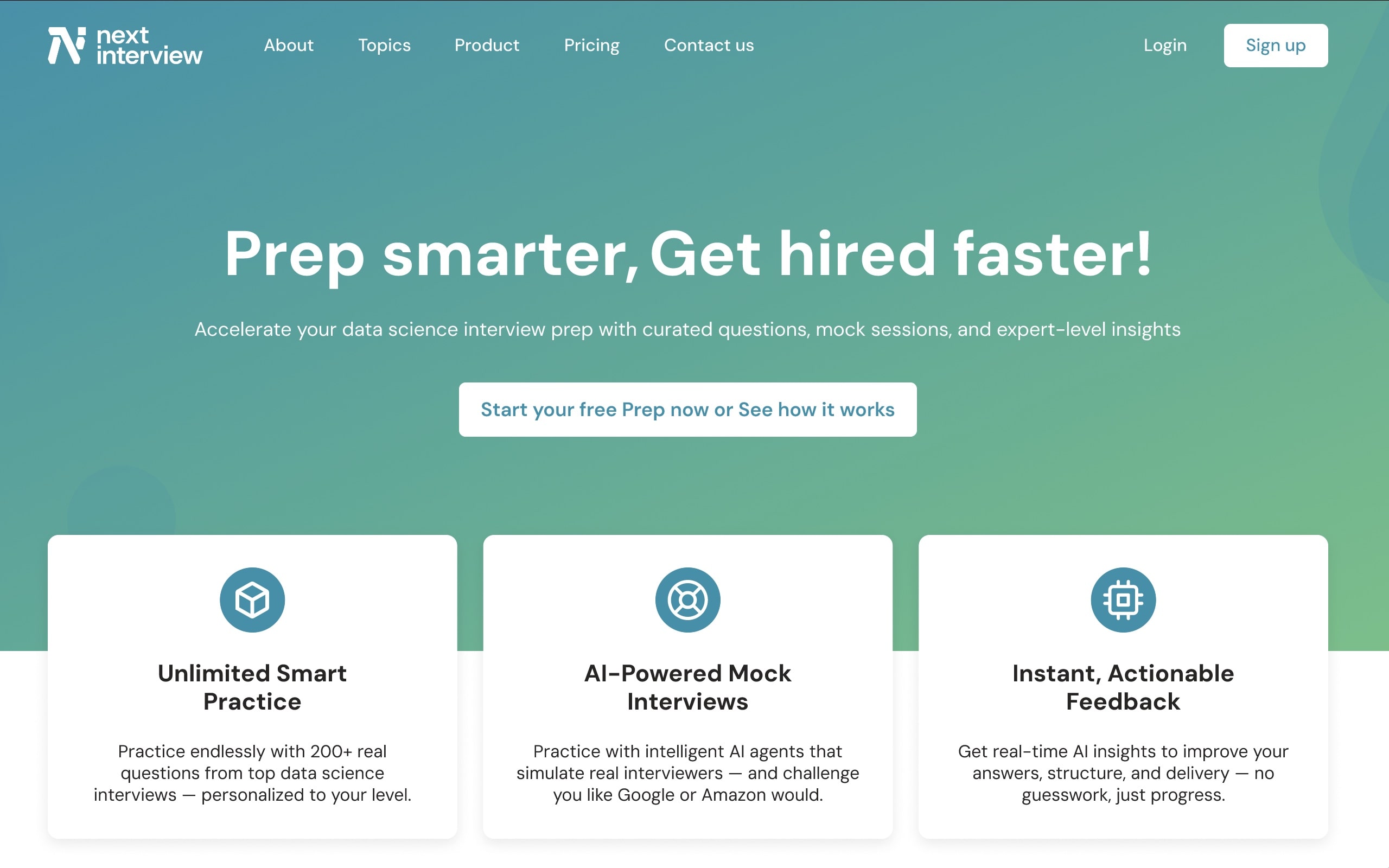
NextInterview.AI is an AI-powered interview prep application. It is designed to guide, challenge, and support you in a way that static courses or endless Googling cannot.
Here’s how it helps:
- Cuts the clutter and highlights where to focus your energy. Instead of spreading yourself thin, it shows you where 80% of your effort should go.
- Personalises preparation based on your role, job description, and trending skills in the market.
- Simulates real interview scenarios, preparing you for difficulty jumps and tricky phrasing that catch many candidates off guard.
- Tracks progress with feedback that feels human, supportive and constructive, without the frustration of vague advice.
This isn’t about replacing human mentors but about scaling personalisation and relevance in ways humans alone cannot.
What NextInterview.AI offers:
1. Approach Analyser
The approach analyser evaluates not only final answers but the candidate’s reasoning and methodology. It provides feedback on the sequence of steps, identifies logical gaps, and suggests alternative ways to approach problems—helping candidates refine how they think, not just what they answer.
2. Topic Summariser:
The topic summariser condenses core concepts from learning modules into concise, reviewable summaries. It surfaces the most relevant ideas and patterns that candidates should master for a given role, reducing noise and ensuring focused study.
3. Code Explainer:
The code explainer breaks down code snippets and implementations into understandable segments, explaining intent, complexity, and edge cases. It helps users understand why a solution works and how it could be improved.
4. Dynamic Difficulty Variations:
Questions and challenges adapt in difficulty as the user progresses. This ensures steady skill growth, exposes candidates to harder scenarios at the right time, and prevents false confidence from practising only easy problems.
5. Code Polish:
Built-in code polish functionality offers optimisations and refinements powered by backend AI. It focuses on readability, performance improvements, and idiomatic usage—helping candidates demonstrate production-ready coding standards.
6. Quick Revise:
Quick revise tools provide compact, high-impact refreshers on core concepts and patterns. These targeted micro-sessions are designed for last-minute review and reinforcing memory retention.
Beta Launch Details:
The public beta goes live on September 15th, 2025. The early release (maybe with minimal features) focuses on AI, ML, and Data Science interview preparation and includes:
- Tailored learning modules for role-specific preparation that adapt to the learner’s strengths and weaknesses.
- Over 200 curated interview questions sourced from real job descriptions, designed to mirror industry expectations.
- Learning aids such as flashcards, quick-revise sessions, and a “check your approach” feature that validates both answers and reasoning.
- AI-driven mock interviews that adjust dynamically to the candidate’s performance and simulate authentic interview pacing and difficulty.
NextInterview intends to expand beyond its initial scope, broadening role coverage and deepening company-specific context over time. The platform’s goal is to reduce uncertainty in interview preparation, giving candidates clarity, confidence, and a measurable path to improvement. For hiring managers, the platform aims to improve the signal-to-noise ratio in candidate evaluation, helping teams identify the right talent more effectively.
September 15th is the start of this journey. NextInterview will iterate with feedback from early users and continue to refine the product to better serve both candidates and hiring teams.