




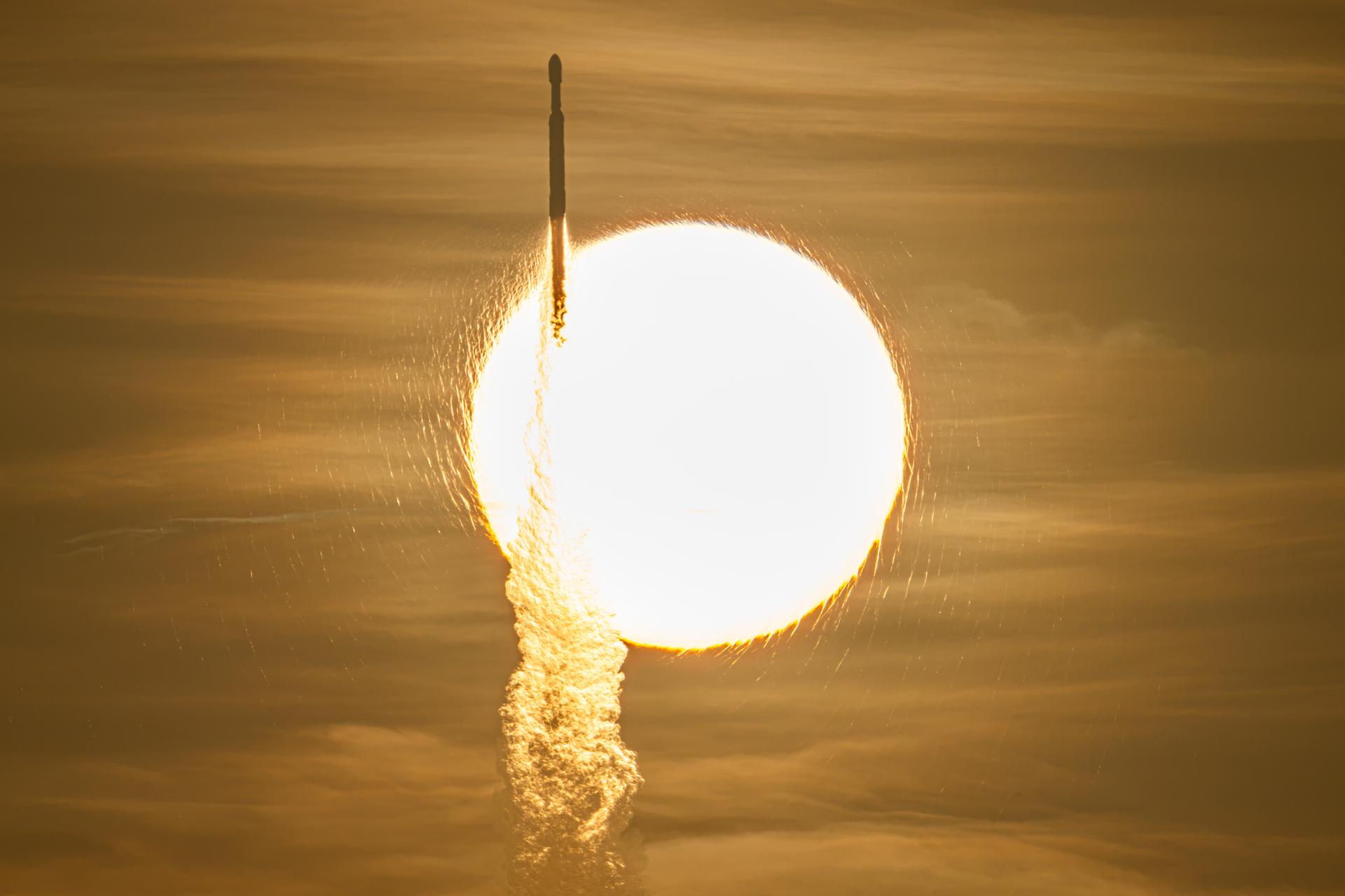
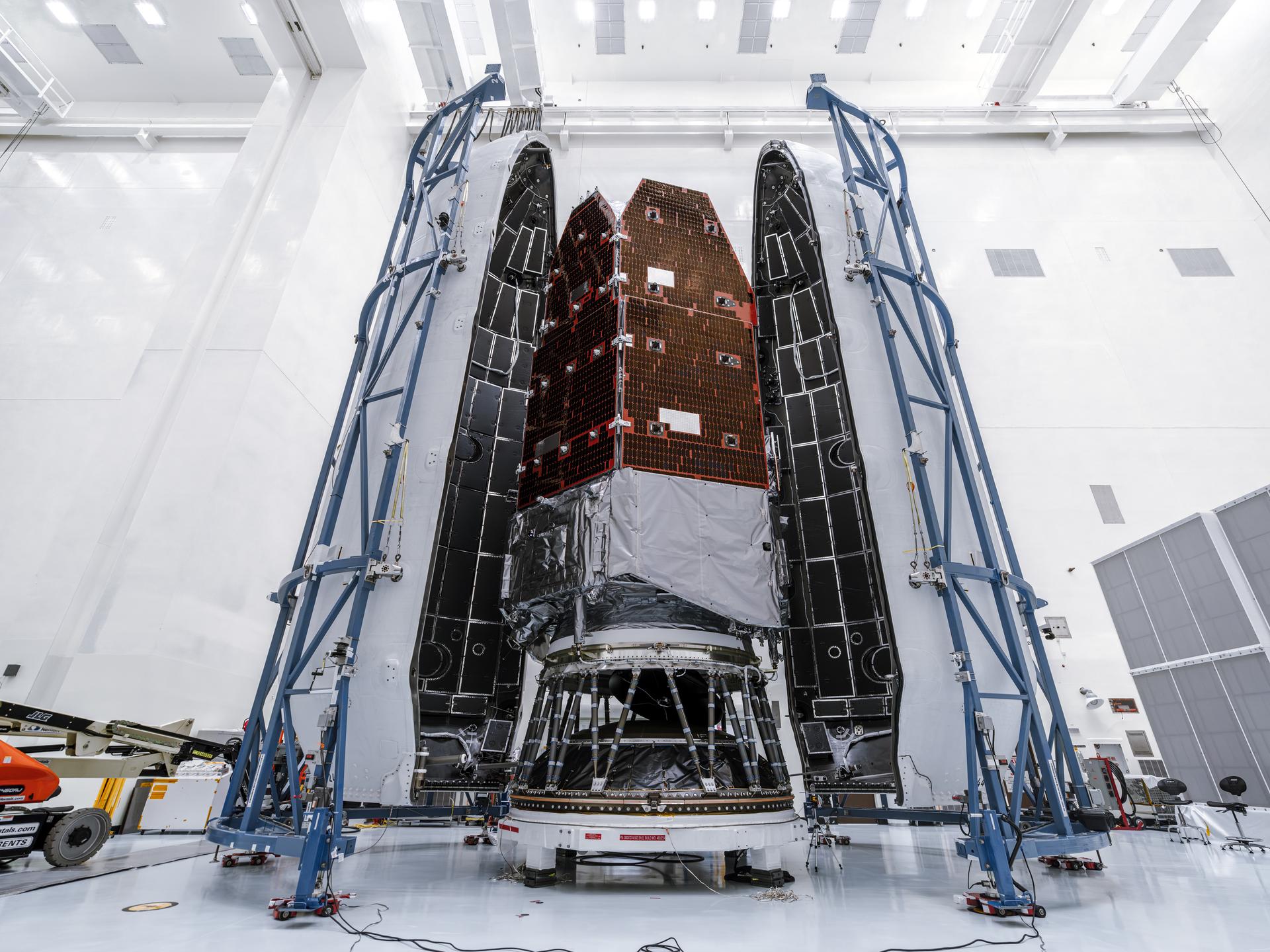
NASA’s Nancy Grace Roman Space Telescope is finally on its way to space, beginning a mission that could change not only what astronomers see, but how they study the universe. A SpaceX Falcon Heavy launched Roman from Kennedy Space Centre on August 30, 2026, sending the observatory towards the Sun-Earth L2 point, about 1.5 million kilometres from Earth and the same general region of space where the James Webb Space Telescope operates. After its journey and commissioning, Roman is expected to begin its primary science mission in 2027.
The launch is an important milestone after more than a decade of development under different names, including WFIRST. But the rocket and the journey to L2 are only the beginning of the story. The more interesting question is what happens when Roman starts doing what it was designed to do: repeatedly survey enormous areas of the sky and turn those observations into one of the largest astronomical datasets ever produced.


That is what makes Roman different from both the Hubble Space Telescope and the James Webb Space Telescope. It isn’t being built to produce sharper images than Hubble or to see deeper into the infrared than Webb. Instead, Roman is designed to observe vastly more of the sky, much faster. And once astronomers can collect information at that scale, the challenge shifts from simply finding interesting objects to processing, analysing and understanding an extraordinary amount of information.
Roman Was Built for a Different Kind of Astronomy
Roman carries a 2.4-metre primary mirror, the same diameter as Hubble’s. Compared with Webb’s enormous 6.5-metre segmented mirror, that might initially make Roman appear less ambitious. The mirror, however, is not the main story. Roman’s real advantage comes from the enormous field of view of its Wide Field Instrument, which is designed to survey large areas of the sky in a fraction of the time that a traditional pointed observatory would require.
The Wide Field Instrument uses 18 large infrared detectors arranged into a mosaic, providing roughly 300 megapixels of imaging capability. Its field of view is approximately 0.281 square degrees, around 200 times larger than Hubble’s WFC3/IR field according to the supplied research. A single Roman exposure can therefore cover an area of sky larger than the apparent size of the full Moon.
The difference becomes important when the objective is not to study one galaxy or one star in extraordinary detail, but to examine millions or billions of objects and look for patterns. Hubble has spent more than three decades producing exceptionally detailed observations of relatively small regions, while Webb uses its larger mirror and highly sensitive infrared instruments to investigate extremely faint and distant targets. Roman takes a different route by covering enormous areas quickly enough to build statistically powerful samples.
NASA estimates that Roman could survey certain galaxy populations at comparable depth up to 1,000 times faster than Hubble. The figure should not be interpreted as Roman producing a thousand-times-better image. Its advantage is the amount of sky it can cover while maintaining useful resolution and sensitivity, allowing astronomers to investigate a scale of the universe that would be extremely difficult to map with Hubble or Webb alone.
The Data May Be Roman’s Biggest Engineering Challenge
Roman’s ability to see so much of the sky brings an obvious consequence that is receiving far less attention than the launch itself: the amount of data it will generate.
The observatory is expected to produce more than 20 petabytes of data during its five-year prime mission. That is an enormous dataset, particularly because Roman will not simply be taking occasional photographs of selected targets. Its survey strategy involves repeated observations across large areas, imaging through multiple filters and wide-field slitless spectroscopy.
The Wide Field Instrument will operate across wavelengths from approximately 0.48 to 2.3 micrometres and includes eight imaging filters along with grism and prism modes for slitless spectroscopy. Instead of placing a spectrograph on one carefully selected galaxy at a time, Roman can obtain low-resolution spectral information across a very large field, helping researchers measure the properties and redshifts of huge numbers of galaxies and stars.
This is where Roman starts to resemble a large-scale technology platform as much as a traditional observatory. The Space Telescope Science Institute is preparing the Roman Research Nexus and associated processing and visualisation tools to help researchers work with the mission’s enormous datasets. The planned data products will include calibrated exposures, combined mosaics and catalogues, alongside specialised processing for areas such as microlensing and time-domain observations.
The underlying problem will be familiar to anyone who works with modern data infrastructure. Once datasets become sufficiently large, repeatedly moving them to individual computers becomes inefficient. A more practical approach is to provide researchers with powerful tools close to where the data is stored, allowing them to search, analyse and process information without having to treat the entire dataset as something that must first be downloaded.
For astronomy, that represents an important change in workflow. Roman’s scientific success will depend not only on its telescope and detectors, but also on the storage systems, processing pipelines, archive infrastructure and cloud-based tools on Earth that can convert an enormous stream of observations into useful scientific results.
What Will the Roman Space Telescope Actually Look For?
The science program is broad, but some of Roman’s most important goals involve questions that cannot be answered properly without very large datasets.
One of them is the mystery of dark energy and dark matter. Roman will use several complementary techniques, including weak gravitational lensing, galaxy clustering and observations of Type Ia supernovae, to study how the universe has expanded and how cosmic structures have evolved. Weak lensing is particularly useful because the gravity of matter subtly distorts the apparent shapes of distant galaxies. Measuring those distortions over enormous areas can help astronomers build maps of the distribution of matter, including dark matter, across cosmic history. The research report expects Roman to study billions of galaxies through weak-lensing measurements and detect thousands of Type Ia supernovae.
Roman will also bring a different perspective to the exoplanet search. Instead of relying mainly on planets passing directly in front of their stars, its microlensing survey will repeatedly monitor dense regions towards the centre of the Milky Way. When the gravity of a foreground star magnifies light from a more distant star, an orbiting planet can create a brief additional signal. This technique is particularly useful for finding colder planets that orbit farther from their stars and could potentially reveal free-floating planets that do not orbit any star at all. The supplied research estimates that Roman’s microlensing survey could discover around 1,200 planets, including potentially Earth-mass worlds.
Galaxy evolution is another major area. Roman’s wide-field imaging and spectroscopy will allow astronomers to study huge populations of galaxies rather than focusing only on individual examples. By combining those observations with repeated surveys, researchers can also study supernovae, variable stars, active galaxies and microlensing events as they change over time. This time-domain capability effectively allows Roman to create an astronomical record of how large portions of the sky evolve.
Roman vs Hubble vs James Webb
The easiest way to understand the three observatories is not to ask which one is the most powerful, because each has been designed around a different scientific priority. Hubble is particularly valuable for high-resolution ultraviolet and optical observations, Webb is built for exceptional infrared sensitivity and depth, while Roman is designed to survey huge areas rapidly and produce statistically powerful datasets.
| Feature | Roman Space Telescope | Hubble Space Telescope | James Webb Space Telescope |
|---|---|---|---|
| Primary mirror | 2.4 m | 2.4 m | 6.5 m segmented |
| Wavelength range | 0.48–2.3 μm | ~0.1–2.5 μm | ~0.6–28.5 μm |
| Location | Sun-Earth L2 | Low Earth orbit | Sun-Earth L2 |
| Main strength | Wide-area surveys and large statistical samples | High-resolution UV and optical observations | Deep and sensitive infrared observations |
| Field of view | ~0.281 deg² | Much smaller | Much smaller |
| Main observing approach | Wide and fast | Targeted and detailed | Deep and sensitive |
| Major science focus | Cosmology, exoplanets, galaxy surveys and time-domain astronomy | Broad astrophysics, UV/optical imaging and spectroscopy | Early universe, galaxies, stars and exoplanet atmospheres |
The comparison makes clear why Roman should not be viewed as a replacement for either telescope. Its mission occupies a different part of the observing landscape, and its value becomes even greater when its observations are combined with those from Hubble and Webb.
Roman Won’t Replace Hubble or Webb
Hubble remains particularly important because Roman cannot observe ultraviolet wavelengths. Hubble’s long experience and high-resolution optical and ultraviolet instruments allow astronomers to investigate phenomena that are outside Roman’s range. Webb, meanwhile, has a substantially larger mirror and can observe much farther into the infrared, reaching approximately 28.5 micrometres compared with Roman’s upper limit of about 2.3 micrometres.
Roman’s role is to survey enormous regions and identify interesting objects, unusual events and statistically important populations. Those discoveries can then provide targets for more detailed observations by Hubble or Webb. A rare galaxy, transient event or possible exoplanet identified by Roman could subsequently be examined at greater depth or at different wavelengths by one of the other observatories.
This creates a powerful find-and-follow-up model. Instead of using precious observing time to search large areas of sky for rare objects, astronomers can use Roman’s surveys to establish where the interesting targets are and then direct Hubble or Webb towards them. Roman provides the scale, Hubble provides ultraviolet and high-resolution optical observations, and Webb provides deeper and longer-wavelength infrared observations.
Roman Has Important Limitations Too
Roman’s strengths naturally come with trade-offs. Its lack of ultraviolet capability means it cannot replace Hubble for UV astronomy, while its infrared coverage ends well before Webb’s mid-infrared range. The faintest, coldest and dustiest targets will therefore remain an important part of Webb’s territory.
Roman will also operate around L2 without the astronaut servicing capability that extended Hubble’s operational life. Reliability and long-term calibration will therefore be especially important. Its coronagraph is another deliberate trade-off: although it is expected to demonstrate advanced techniques for directly imaging exoplanets, it is primarily a technology demonstration rather than the central science instrument of the mission.
There is also a less visible risk. Generating more than 20 petabytes of observations is useful only if the systems on Earth can store, calibrate, process and deliver that information efficiently. Roman’s data infrastructure is therefore not a supporting detail around the mission; it is part of the mission’s scientific capability.
The Real Roman Revolution Starts After Launch
The Falcon Heavy launch is the dramatic part of Roman’s story, but it is not what will ultimately determine its scientific legacy. The real test begins after the spacecraft reaches L2, completes commissioning and starts repeatedly surveying the sky.
For decades, some of astronomy’s most memorable discoveries have come from studying individual objects in extraordinary detail. Roman adds another approach: building enormous statistical samples and looking for patterns across billions of galaxies and stars. That shift could help scientists investigate dark energy, map dark matter, understand galaxy evolution, search for distant planets and identify rare transient events in ways that simply were not practical before.
The 20-petabyte dataset is therefore more than an impressive number. It represents a fundamental change in the scale at which astronomy can operate. Roman is effectively turning large parts of the sky into a massive searchable dataset, and the infrastructure required to make sense of that information will become an increasingly important part of the scientific process.
This is also what makes Roman relevant beyond astronomy. The same basic problem is appearing across technology: sensors are becoming more capable, systems are producing more information and traditional methods of moving and processing that information are reaching their limits. NASA’s response—large-scale storage, specialised pipelines, cloud-based analysis and tools that allow researchers to work closer to the data—is a particularly ambitious example of a challenge that businesses and technology teams are already facing at smaller scales.
Roman’s launch, then, is not simply the arrival of another space telescope. Hubble changed our view of the universe by giving us extraordinary detail, while Webb has pushed our view deeper into the infrared and towards the earliest stages of cosmic history. Roman adds something different: the ability to observe the universe at enormous scale.
The first images will come only after the spacecraft reaches L2 and completes commissioning, but the bigger scientific story has already begun. The question is no longer simply how far humanity can see into space. With Roman, it is increasingly becoming a question of whether we can build the technology on Earth capable of keeping up with everything the universe is about to show us.